https://www.dailynews.com/news/ci_18004281

ODOR: Complaints by residents against Sunshine Canyon have increased tenfold in two years.

(South Coast Air Quality Management)

SYLMAR – A pungent odor emanating from the Sunshine Canyon landfill over the last two years has left nearby residents holding their noses and local officials scratching their heads.

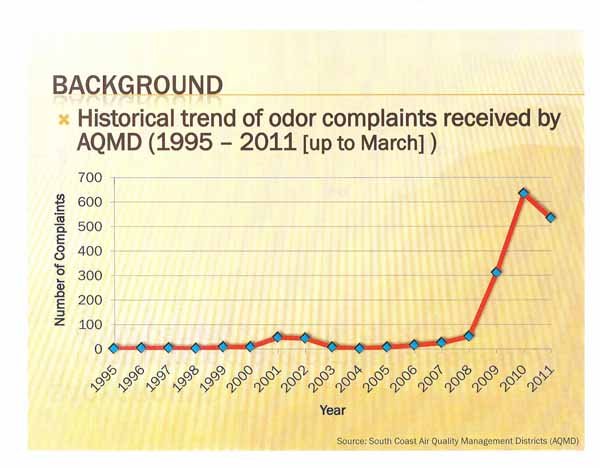
The number of complaints about foul smells from the landfill wafting over neighborhoods and schools has jumped more than tenfold in the last two years, according to state officials. More than 600 complaints were registered in 2010, compared to less than 50 in 2008.

This year since Jan. 1 alone, at least 676 complaints have been filed with the South Coast Air Quality Management District.

“How much is enough for this community?” said a frustrated Wayde Hunter, president of North Valley Coalition, a nonprofit organization which was formed more than 20 years ago.

“There’s just been an exponential increase in days when there is an odor,” he said. “I’m frantic, I just don’t know what to do.”

But the landfill’s operators and local environmental officials have yet to discover the source of the stench.

Sunshine Canyon Landfill, which takes in 9,500 tons of trash each day, is run by Republic Services, one of the largest integrated waste management companies in the United States.

“We know there is an odor issue, and that is unacceptable to us,” said Peg Mulloy, spokeswoman for Republic. “Right now, we don’t know where (the odor is) coming from. We’re focusing all our efforts on trying to find the problem.”

Mulloy said new general manager David Cieply has been hired as part of the company’s effort to bring in new people to help solve the problem at the landfill.

“The key is, we admit that there are odors and we know there is a problem,” she said. “We know people are unhappy.”

The AQMD has issued 15 violations against operators of the landfill so far this year, compared to four for the same time period in 2010.

The landfill, at 14747 San Fernando Rd., in Sylmar is about two miles north of Van Gogh Elementary School in Granada Hills, where children, parents, and teachers complain they smell a foul odor each morning until about 10 a.m.

“It usually dissipates by recess,” said Gale Gundersen, who called in a complaint to the AQMD on Thursday.

She said the increase in odors began last year.

“It’s a strong garbage smell,” she said.

The AQMD violation notices do not come with fines, but the agency in January ordered the landfill to fix the problem, said Sam Atwood, a spokesman for the air-quality regulating agency.

In very rare circumstances, a landfill is ordered to cease operations, Atwood said. “We’ve received hundreds of complaints and that shows there is a problem,” Atwood said.

The Los Angeles Unified School district is documenting the problem as well. So far, the district has no accounts of students who have been sickened or hospitalized because of the odor, said John Sterritt, director of environmental health and safety for LAUSD.

“The kids are overcome by the odor, and we think that’s a really big problem,” said Bill Piazza, an environmental assessment coordinator for LAUSD.

Along with the AQMD, Los Angeles city and county officials last month formed a 90-day action plan. Landfill operators are supposed to reduce the number of trucks delivering trash during peak hours, use soil, instead of tarps, to cover the trash at the end of the day, and install several DustBoss odor control units in areas where trash is deposited.

Landfill operators also must conduct odor patrols from 6 to 10 a.m. and 6 to 10 p.m. Mondays through Saturdays.

The city and county formed a joint enforcement team in 2008 to supervise Sunshine Canyon. Sunshine is actually two side-by-side landfills – one on city land, one in county jurisdiction – that merged operations in 2009.

“We’re very concerned about it,” said Tony Bell, spokesman for Los Angeles County Supervisor Michael D. Antonovich, whose district includes the landfill. He said the county Department of Public Works has been in talks with Republic to make sure the 90-day plan of action is implemented.

While no cause is known for sure, city and county officials speculate the odor could be caused by types and quantities of trash received, methods of handling the trash, and/or a faulty landfill gas collection system among other factors.

City Councilman Greig Smith said officials are collecting all the notices of violation as well as other information, in case legal action against the operators of the landfill becomes necessary.

“We can order them to close the doors which is in our purview,” Smith said. “The onus is on their backs to perform. It’s taken so ridiculously long.”
https://topochange.cr.usgs.gov/landfills.php

Topographic change due to landfill operations has been observed based on some of the features delineated by the elevation differencing and thresholding process. The resulting altered landforms from landfills differ from other anthropogenic activities in that much of the deposited material is not rock and soil that had been previously excavated but man-made material that has been transported to the deposition site.

The figure below shows the Sunshine Canyon landfill in Sylmar, California, an example of topographic change due to landfill operations. The operation and expansion of this landfill continues to be a controversial topic in the local area. The close proximity of the landfill site to a major transportation artery is a reminder that visual impacts of human geomorphic activities can be significant.

the Sunshine Canyon landfill in Sylmar, California
Topographic surface change resulting from landfill operation (Sunshine Canyon landfill in Sylmar, California). The images are NED shaded relief (upper left), SRTM shaded relief (upper right), aerial photograph (lower left), and perspective view (lower right). Change polygons (blue = cut; red = fill) have been overlaid on each image. The arrow indicates the view direction (toward the southwest) for the perspective view.

The state will monitor Sunshine Canyon until a local body is set up.

Adding another wrinkle to a decades-old controversy over a giant dump in the north San Fernando Valley, the state has approved a request by the operator of Sunshine Canyon Landfill to step in and oversee enforcement of waste laws at the facility until a city-county joint agency is approved.

Sunshine Canyon is actually two landfills roughly a quarter of a mile apart, which puts them in different jurisdictions: one in the city of Los Angeles, the other in unincorporated county territory.

For The Record
Sunshine Canyon: An article in the June 30 California section about the Sunshine Canyon Landfill said the dump sits atop an underground reservoir that holds water for 19 million people. The San Fernando Groundwater Basin is one mile south of the dump, and only non-potable water lies under the dump. Also, the article stated that Greg Loughnane, a spokesman for Browning-Ferris Industries, said company officials wanted to combine the two dumps at the site into one because a single dump would be less expensive to operate. In fact, Loughnane said the sole reason for seeking to merge the two was concern they would run out of room for garbage.

https://www.thefreelibrary.com/CLOSING+YEAR+IFFY+FOR+LANDFILL.-a0138291833

Sunshine Canyon Landfill could take in up to 57 million tons more trash than officials have predicted, potentially extending the life span of the Granada Hills dump far past the 26 years that are expected, according to a consultant hired by dump opponents.

At the request of attorneys hired by local activists, Wisconsin-based landfill engineer J.W. Spear analyzed trash decomposition and compression to show that Browning Ferris Industries underestimated the dump’s 90-million ton capacity and 26-year life span. Longtime Granada Hills activists in the North Valley Coalition now have the backing of national environmental giants, the Sierra Club and Natural Resources Defense Council, plus the International Brotherhood of Teamsters, which represents BFI’s workers, in their fight over Sunshine Canyon.

Spear’s report was submitted to Los Angeles County officials this week. The county’s Regional Planning Commission is considering a new land-use permit for Sunshine Canyon Landfill today.

The newly formed coalition of residents, environmental groups and organized labor is pushing for a guarantee that the landfill will close when it reaches 90 million tons or after 26 years – as officials have always estimated. Currently, the permit allows BFI to keep adding trash until the dump is full – even years longer than anticipated.

“A closure date would be advantageous and give an end point to the agony that surrounding communities have suffered,” said Jan Chatten-Brown, an attorney representing Protect Our Water and Environmental Resources, or POWER.

The Teamsters local, whose contract with BFI expires in 2007, decided to join to coalition because its members are residents of the community, said spokeswoman Leigh Strope.

“They are concerned about the impact this landfill is having on the health and safety of their families and their children.”

In Sun Valley, the Teamsters have rallied to support BFI competitor, Waste Management, which has proposed to expand Bradley Landfill and build a transfer station.

BFI District Manager Greg Loughnane said the POWER coalition’s request is misguided. The closure date is an estimate. The landfill’s permit regulates the footprint of the dump, not its capacity or life span.

“Market conditions will dictate when the landfill will close,” he said.

Carlos Ruiz, with Los Angeles County Department of Public Works’ Environmental Programs, said his group’s previous analysis conflicts with Spear’s report. County analysts found Sunshine Canyon Landfill can take about 92 million tons and last an extra year or two at the most.

BFI is seeking a new land-use permit to combine two separate dumps – one in county jurisdiction and one in city jurisdiction – into one massive landfill. The joint landfill could take in up to 12,100 tons of trash per day, generating an estimated 2,500 truck trips a day.

https://www.enn.com/top_stories/article/16728

SANTA MONICA, California — The Sunshine Canyon landfill in the San Fernando Valley could expose residents in the region to more trash for a far longer period than they are being told, according to Protect Our Water and Environmental Resources (POWER), a coalition of environmental and labor groups dedicated to protecting residents of Southern California from the dangers of landfills. The community surrounding Sunshine Canyon should not be forced to bear the burdens of the landfill for longer than governmental reports previously represented.

A permit proposal for Sunshine Canyon, submitted by BFI/Allied Waste, will be considered at a hearing Thursday at the Los Angeles County Regional Planning Commission. Area residents should know that previous environmental documents stating that the facility has the capacity to receive 90 million tons and would close after about 26 years are unreliable. This is because there is no provision guaranteeing that the landfill will close when it receives 90 million tons or after 26 years. POWER is requesting that the Commission require a tonnage limit or closure date.

Sunshine Canyon could actually take in much more waste than 90 million tons, according to a new study prepared for the coalition by landfill engineer J.W. Spear, who has more than 25 years of experience in the waste management industry. The study found that 24 million to 57 million more tons of waste could go into the landfill, on top of the 90 million that has been projected.

“Mr. Spear’s credentials are impressive and the North Valley Coalition believes his conclusions support our contention that this landfill will be much larger than analyzed in the environmental documentation. Its impacts on the community, indeed the city and county as a whole, have not been adequately addressed,” said Wayde Hunter, President of the North Valley Coalition, which represents residents in the area of the landfill.

Because the tonnage determines the closure date of the landfill, this could mean that the landfill would operate far longer than the 26 years now estimated. There is no requirement that will force the landfill to close when 90 million tons have been deposited or when 26 years have elapsed.

“The North San Fernando Valley continues to suffer from the negative effects of the Sunshine Canyon Landfill. The time has come to put an end to this environmentally polluting practice and start recovering our waste for beneficial use as described in my RENEW LA plan,” said Los Angeles City Councilmember Greig Smith.

The POWER coalition includes the North Valley Coalition, Sierra Club, Natural Resources Defense Council, Environmental Law Foundation, and the International Brotherhood of Teamsters.

https://waste360.com/news/los-angeles

The Los Angeles City Council has agreed to pay for a study on urban landfills using funds from a trust fund created a decade ago by the operators of Sunshine Canyon landfill. The $100,000 to be used is the last of the money remaining in the $1 million fund created by Browning Ferris Industries, the landfill’s operator.

The study will look at ways the city can deal with landfills and the city’s trash over the next 20 years. Los Angeles Mayor James Hahn has promised to stop using Sunshine Canyon for residential trash disposal by 2006 and will fight the use of urban landfills. There is a June 2005 deadline for the city to decide the fate of its contract with Sunshine Canyon.

https://articles.latimes.com/1991-09-28/local/me-2909_1_sunshine-canyon-landfill

A judge Friday temporarily halted the beginning of construction on the expansion of Sunshine Canyon Landfill into 200 acres of Los Angeles County-controlled land above Granada Hills.

Construction was set to start Monday–two weeks before a lawsuit opposing the dump expansion is scheduled to be heard.

Los Angeles Superior Court Judge Ronald M. Sohigian issued a temporary restraining order halting the project at the request of the city of Los Angeles, which is suing Los Angeles County and Browning-Ferris Industries, the landfill’s owner.

https://www.wasterecyclingnews.com/landfill/landfill-report.html?id=1306942437

Biodegradable products, such as disposable cups and utensils, may be doing more harm than good in landfills, according to researchers from North Carolina State University.

The study, which was published online in Environmental Science & Technology, found that so-called eco-friendly products release a powerful greenhouse gas as they break down.

The problem is attributable to the rate at which biodegradable materials break down, the study found. According to Federal Trade Commission guidelines, products marked as biodegradable should decompose within “a reasonably short period of time” after disposal.

But that rapid deterioration may be environmentally harmful, the researchers found.

Federal regulations do not require landfills that collect methane to install gas collection systems for at least two years after the waste is buried. If materials break down and release methane too quickly, the study said, much of the methane will likely be emitted before the collection technology is installed. This means less potential fuel for energy use and more greenhouse gas emissions.

The researchers found that a slower rate of biodegradation is more environmentally friendly because the majority of the methane production will occur after the methane collection system is in place.

“Methane can be a valuable energy source when captured, but is a potent greenhouse gas when released into the atmosphere,” said Morton Barlaz, co-author of the study and a professor and head of N.C. State’s Department of Civil, Construction and Environmental Engineering, in a statement. “In other words, biodegradable products are not necessarily more environmentally friendly when disposed of in landfills.”

https://www.wasterecyclingnews.com/landfill/landfill-report.html?id=1302571046

April 12 — New research out of North Carolina has discovered exactly why landfills produce methane.

North Carolina State University researchers said they have identified a species of microbe — Methanosarcina bakeri — that “appears to be the key” to allow production of the gas.

“Landfills receive a wide variety of solid waste, and that waste generally starts out with a fairly low pH level,” said Francis de los Reyes, an associate professor of civil engineering and co-author of a paper describing the research.

“The low pH level makes it difficult for most methanogens — methane-producing organisms — to survive. We started this project in hopes of better understanding the mechanism that raises the pH level in landfills, fostering the growth of methanogens,” de los Reyes said.

Researches discovered that the microbe M. bakeri survives in at low pH levels, consumes acids and produces methane. This increases pH levels and makes an area “more amenable for other methanogens,” the school said.

Moisture leaching through a landfill then spreads the high pH levels, allowing other parts of the disposal site to continue the process, research shows.

“The research community can use our findings to explore ways of accelerating the methane-generation process,” de los Reyes said, “creating methane more quickly for power generation and making additional room in the landfill for waste disposal.”

The findings are explained in a paper, “Effect of Spatial Differences in Microbial Activity, pH, and Substrate Levels on Methanogenesis Initiation in Refuse,” that´s being published in the April issue of “Allied and Environmental Microbiology.”

The paper was co-authored by Bryan Staley, who is president and CEO of the Environmental Research and Education Foundation, de los Reyes, and Morton Barlaz, a professor and department head of civil, construction and environmental engineering at N.C. State. Research funding was provided by Waste Management Inc. and the foundation. Staley worked on the project while he was a doctoral student at the university.